
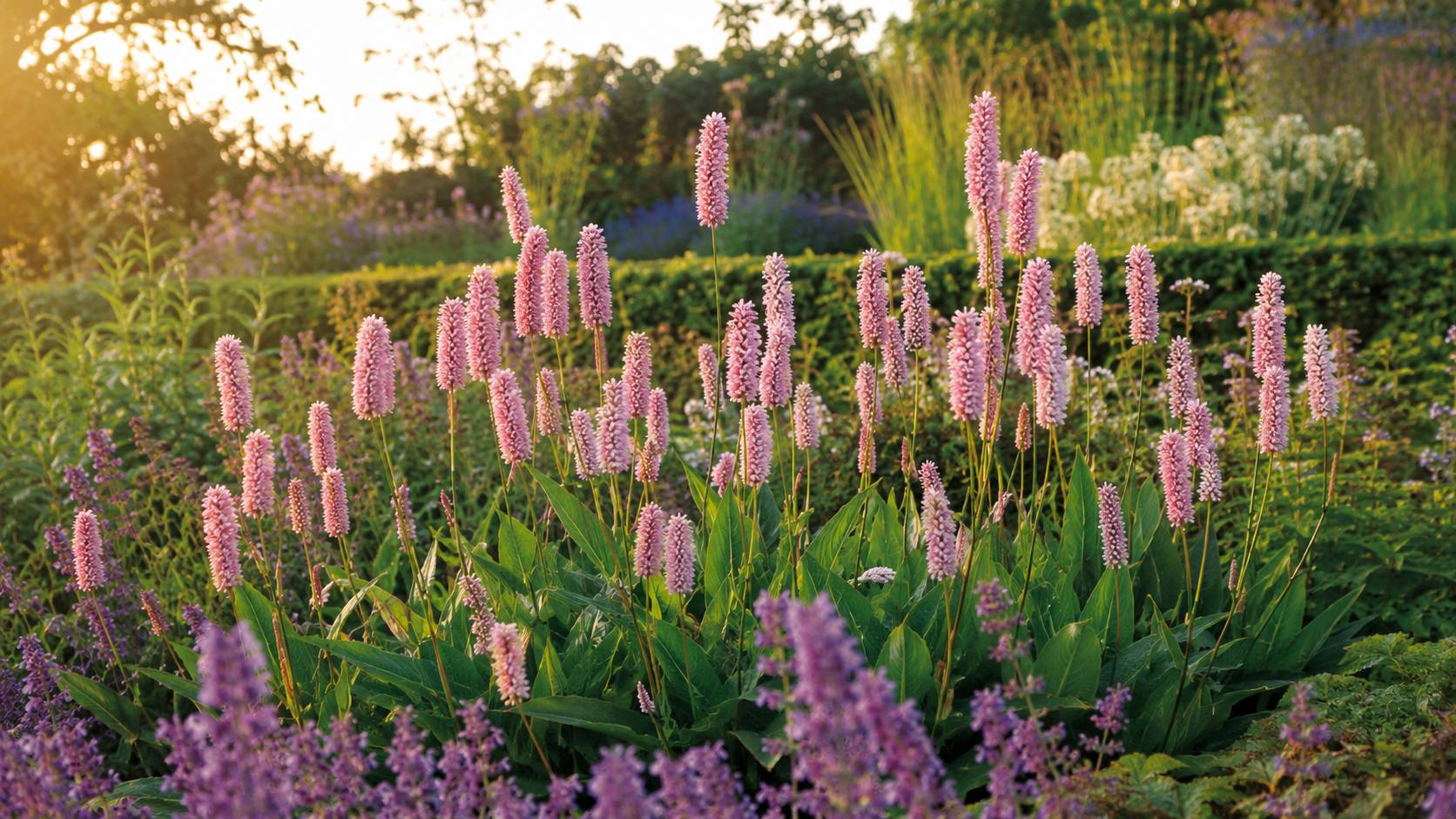
If you crave a perennial that delivers weeks of elegant bloom, unshakeable reliability, and a softness that flatters every plant around it, it’s time to meet bistort. Often overshadowed by louder garden stars, Persicaria bistorta and its cousins quietly form the backbone of some of the world’s most memorable gardens. Their bottlebrush spikes of pink, crimson, or white rise above generous clumps of green, bridging the gap between formal structure and wild romance.
Whether you’re designing a rain garden that stays soggy after every storm, a pollinator paradise, or a layered perennial border that looks good from spring through frost, bistort steps up without complaint. In this guide, you’ll learn exactly how to use bistort plants in the landscape – where they shine brightest, which varieties to choose, and how to pair them for painterly effects that stop visitors in their tracks.
What Exactly Is Bistort?
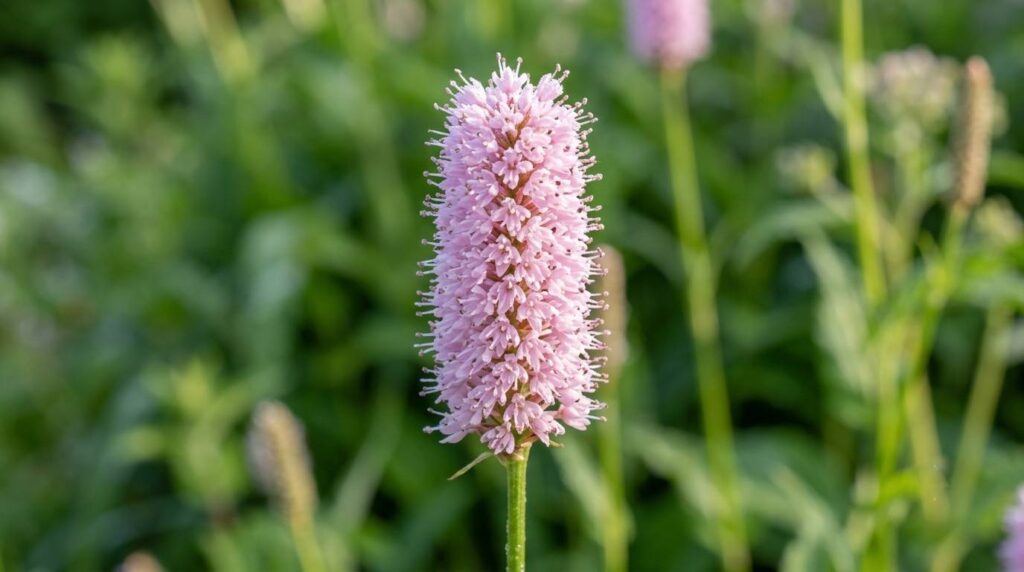
Bistort is a hardy herbaceous perennial native to damp meadows and stream banks across Europe and Asia. Today’s ornamental selections have been refined for garden performance, offering dense, poker-like flower spikes and handsome, often semi-evergreen foliage. The blooms appear in late spring and keep coming well into summer, with some modern cultivars flowering from June until the first hard frost.
Why professional landscape designers love it:
- Thrives in moist, heavy soil where many perennials rot
- Long blooming window with minimal deadheading
- Strong upright habit that adds vertical rhythm
- Deer and rabbit resistance
- A magnet for bees, butterflies, and beneficial hoverflies
- Cold hardy to USDA zone 4
Why Bistort Belongs in Your Design Toolkit
Bistort is the quiet achiever. It never screams for attention, yet its absence would leave a border feeling flat. Here’s what sets it apart:
- Architectural flower spikes – They punctuate planting beds like living exclamation points, drawing the eye upward without looking stiff.
- Long-lasting foliage – Broad, pointed leaves form a weed-suppressing carpet that stays attractive from spring until hard frost.
- Wet soil superstar – If you’ve ever lost plants to winter wet or a poorly draining corner, bistort will become your new best friend.
- Minimal maintenance – Divide every 3-5 years, water deeply during drought, and that’s about it.
- Seasonal adaptability – Looks equally at home in a frothy June garden as it does mingling with autumn grasses in September.
Designing with Bistort: 6 Landscape Applications That Work
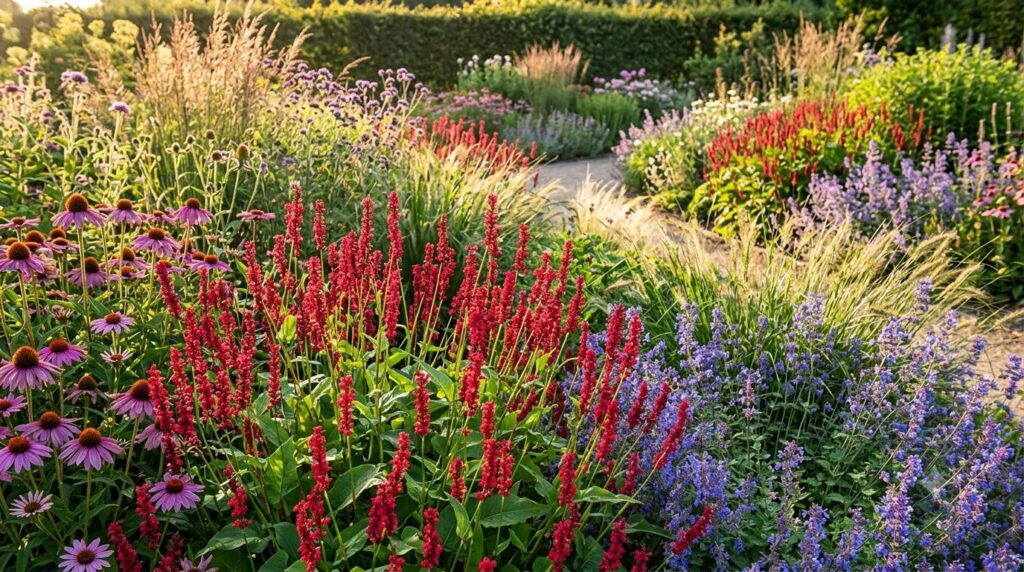
1. Mixed Perennial Borders
Bistort’s vertical lines provide the perfect counterpoint to rounded flower forms like coneflowers, phlox, and yarrow. Plant it in the middle of the border, where its blooms can peek between earlier and later performers.
Designer trick: Use the crimson spires of ‘Firetail’ to echo the red centres of Helenium or the burgundy foliage of a smoke bush behind them.
2. Rain Gardens & Moisture Swales
Bistort roots hold soil on slopes while thriving in the damp conditions that make rain gardens function. Plant it beside water-loving natives to create a flood-proof tapestry.
Perfect partners:
- Blue flag iris (Iris versicolor)
- Joe-Pye weed (Eutrochium purpureum)
- Cardinal flower (Lobelia cardinalis)
- Tussock sedge (Carex stricta)
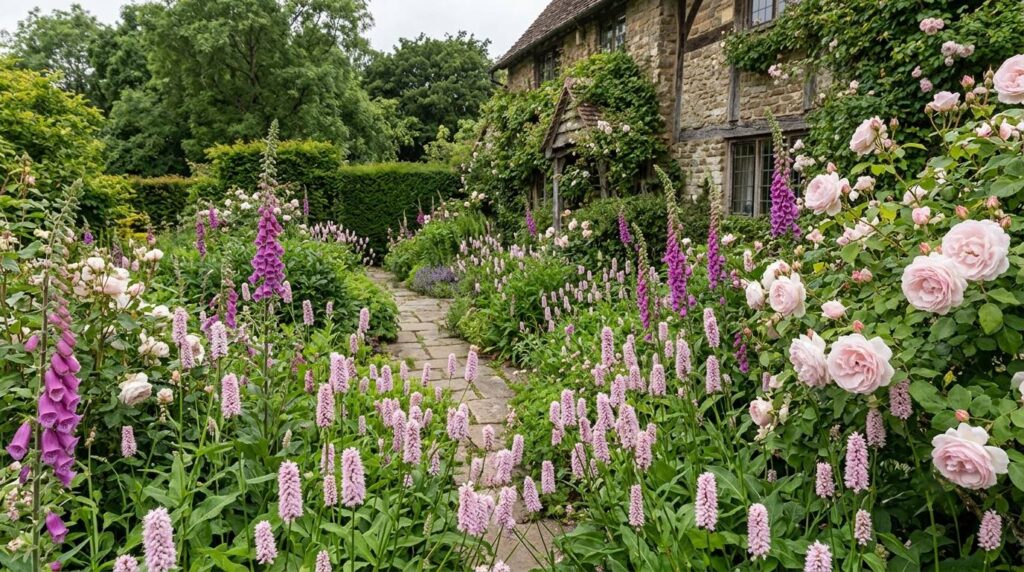
3. Romantic Cottage Gardens
The loose, informal spikes of bistort blend into cottage-style plantings like they’ve always been there. Allow it to weave through shrub roses, foxgloves, and lady’s mantle, and the garden will look effortlessly layered.
Pair ‘Superba’ with lavender, delphiniums, and a tumble of hardy geraniums at its feet for a classic English garden moment.
4. Pond Margins & Stream Banks
If you’re lucky enough to have a natural water feature, bistort will lean gracefully over the edge, its blooms mirrored in the surface. It stabilizes banks and provides cover for frogs and dragonflies.
Plant it with: marsh marigold, ligularia, and rodgersia for a big-leaf, high-drama display.
5. Woodland Edge & Dappled Shade
In brighter shade beneath open-canopy trees, bistort grows lush and blooms reliably. Its broad leaves contrast beautifully with fine-textured ferns and airy grasses.
Shade combo to try: Bistort + Japanese forest grass (Hakonechloa) + hosta + brunnera ‘Jack Frost’.
6. Modern Naturalistic Drifts
Influenced by the New Perennial movement, mass bistort in groups of seven or more, interplanted with grasses like switchgrass (Panicum) or moor grass (Molinia). The effect is a living meadow that moves in the breeze.
The Best Bistort Varieties for Landscaping
| Variety | Flower Color | Height | Bloom Period | Standout Feature |
|---|---|---|---|---|
| Persicaria bistorta ‘Superba’ | Soft pink | 24-30 in | May–July | Classic, vigorous, excellent for borders |
| Persicaria amplexicaulis ‘Firetail’ | Bright crimson | 36-48 in | June–October | Longest bloomer, superb with grasses |
| Persicaria amplexicaulis ‘Rosea’ | Pale shell pink | 30-36 in | July–September | Gentle colour for shaded gardens |
| Persicaria amplexicaulis ‘Blackfield’ | Deep ruby red | 36-42 in | June–October | Dramatic, ideal for contemporary schemes |
| Persicaria affinis ‘Darjeeling Red’ | Pink to red | 10-12 in | June–September | Ground-covering, excellent for front of border |
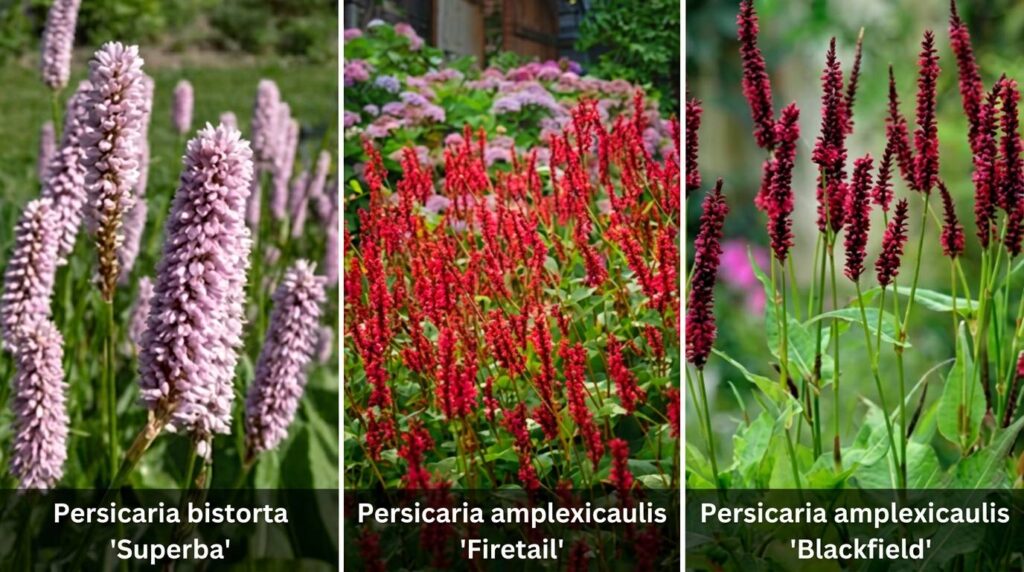
Companion Planting: Create Lush, Layered Combinations
Bistort shines brightest when its form and foliage play off contrasting plants. Keep these time-tested pairings in your back pocket.
Contrasting Forms
- Spiky + flat: Bistort’s spikes next to yarrow or sea holly’s flat umbels
- Broad leaf + fine texture: Pair with threadleaf coreopsis or Russian sage
- Vertical + billowy: The spires rising through a cloud of Mexican feather grass
Colour Harmonies
- Soft pink bistort + blue salvia + white gaura = cool, serene palette
- Crimson bistort + yellow black-eyed Susan + purple agastache = bold, energetic scheme
- White-flowered bistort (e.g., P. amplexicaulis ‘Alba’) + silver artemisia + pale pink phlox = moonlit glow
Season Extenders
Plant alliums and late tulips for spring interest before bistort blooms, and interplant with asters and sedums to keep the show going into autumn.
Growing Conditions at a Glance
| Requirement | Ideal Conditions |
|---|---|
| Light | Full sun to partial shade (afternoon shade in hot climates) |
| Soil | Moist, humus-rich, tolerates heavy clay |
| Water | Medium to wet; thrives in boggy spots |
| Hardiness | USDA zones 4–8 |
| Mature Size | 18–48 inches tall by 18–36 inches wide, depending on variety |
| Spacing | 18–24 inches apart for massing |
Care & Maintenance
Watering
Keep soil consistently moist during the first year. Once established, bistort handles short dry spells, but a deep soak once a week during summer heat keeps foliage lush and blooms coming.
Feeding
Top-dress with a 2-inch layer of compost each spring. Avoid high-nitrogen fertilizers, which encourage floppy growth.
Deadheading
Snip spent flower spikes down to the next set of leaves to tidy the plant and occasionally encourage a second flush. Left standing, seed heads add winter interest.
Division
Every 3 to 5 years, lift and divide clumps in early spring or fall. This rejuvenates growth and provides free new plants.
Pests & Problems
Bistort is almost bulletproof. Occasional leaf scorch in prolonged drought and reduced flowering in heavy shade are the only common complaints. Consistent moisture solves both.
Frequently Asked Questions
Does bistort spread aggressively?
No, ornamental clump-forming varieties expand slowly and stay well-behaved. Avoid aggressive species.
Is bistort really deer resistant?
Yes. Deer rarely browse it, making it a valuable plant for rural and suburban gardens with high deer pressure.
Can I grow bistort in containers?
Absolutely. Use a large, moisture-retentive pot and a loam-based compost. ‘Superba’ and the lower-growing ‘Darjeeling Red’ perform well in containers placed in partial shade.
How do I propagate bistort?
Division is easiest. Dig up a clump in spring, tease apart sections with roots and shoots, and replant at the same depth.
When should I cut it back?
Leave stems standing over winter for structure and wildlife. Cut back old foliage to the ground in early spring just as new growth appears.
Final Thoughts: Why Bistort Deserves a Spot in Every Garden
Bistort is the plant you’ll recommend to every gardening friend after you’ve grown it once. It fills difficult wet spots, bridges the colour gap between spring and summer, and asks for almost nothing in return. Its soft spikes bring a gentle rhythm to borders, and its resilience in heavy soil solves a problem that defeats many other perennials.
For a landscape that feels thoughtfully designed yet wonderfully alive, start by planting bistort in generous drifts. Pair it with contrasting forms, repeat it through your beds, and let the pollinators feast. Your garden will not only look more professional—it will feel more alive.
Ready to start designing with bistort? Pick your favourite variety, choose a damp, sunny spot, and get planting this season. The bees will thank you.
Did this guide inspire you? Pin it for later or share it with a fellow gardener designing their dream landscape!
Leave a Reply